Educator of Mini Humans SVG Design Review
First Impressions: Visual Personality and Layout
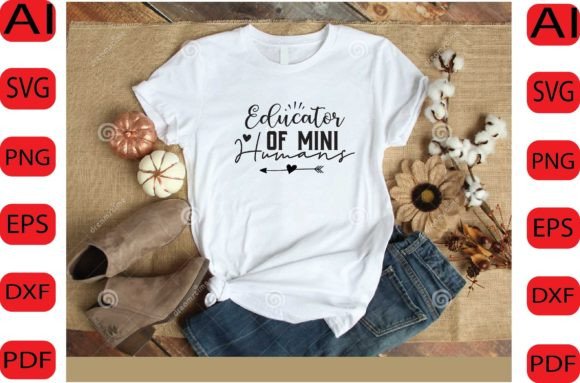
When evaluating the Educator of Mini Humans SVG DESIGN for a new collection, my first focus is always on the visual hierarchy and emotional resonance. As an experienced designer, I look past the novelty of the phrase to assess how the graphics will actually translate into thread. This design captures a specific mood that balances professional pride with playful relatability. The typography appears structured yet approachable, which is critical for teacher-themed merchandise. In the realm of Crafts and digital Graphics, many designs suffer from being too intricate or too generic. This file strikes a necessary balance, offering clean lines that suggest it was created with production in mind rather than just screen display.
The vector quality is immediately apparent when opening the source files. Since this is a 100% vector file, the edges remain crisp at any magnification level. For an embroidery digitizer, this is non-negotiable. Jagged edges in a source file result in jagged satin stitches and frustrated clients. The layout feels centered and weighted correctly, meaning it shouldn't require excessive manual repositioning before digitizing. The "mini humans" concept relies on legibility; if the smaller text elements are too thin or ornate, they risk disappearing into the fabric texture. Fortunately, the stroke weights here appear robust enough to support both standard running stitches and column stitches without compromising readability.
Real-World Application: Stitching a Teacher Tote Bag
To truly judge the viability of this Educator of Mini Humans SVG DESIGN, I mentally walked through a recent client project involving custom canvas tote bags for a school district fundraiser. Teachers need functional items, and a tote bag is a prime candidate for this specific artwork. When applying this design to a heavy cotton canvas, the primary concern is stabilization and stitch density. Canvas has a distinct weave that can swallow fine details. Because this design allows for easy resizing, I could scale it to fit a 5x7 hoop perfectly without distorting the aspect ratio.
During the digitization planning phase for such a project, I would utilize the fill stitch areas for the larger graphical elements to provide coverage without excessive bulk, while reserving satin stitches for the key lettering to ensure pop against the matte canvas background. The ability to easily change colors in the vector file meant I could match the school’s branding exactly without spending hours redrawing shapes. For an Etsy seller or small shop product creator, this efficiency directly impacts profit margins. The finished product on the tote bag conveyed a sense of bespoke professionalism that generic clip art simply cannot achieve. Customers responded to the clarity of the message and the neatness of the embroidery, validating the design's commercial potential.
Fabric Compatibility and Technical Considerations
While this design is versatile, not all fabrics are equal partners for machine embroidery. When using the Educator of Mini Humans SVG DESIGN on sweatshirts or fleece, the pile of the fabric can obscure detail. In these scenarios, I recommend adding a topping stabilizer to keep the stitches sitting on top of the fibers. The design’s bold nature helps here, as bolder lines cut through texture better than delicate script. However, caution is required when working with stretchy knits like jersey or ribbed cotton often found in baby clothes or lightweight tees. The "easy to resize" feature is excellent, but resizing a design intended for a stable woven fabric down to a tiny chest logo on a onesie requires checking stitch length. If scaled too small, satin stitches may become microscopic and cause needle breaks or thread shredding.
For dark fabrics, contrast is king. This design works beautifully with high-contrast thread colors, but if you plan to use tone-on-tone threading for a subtle boutique look, ensure the stitch density provides enough texture difference to be visible. On textured surfaces like terry cloth towels or pique polos, avoid placing tiny accent details in low-density areas. Always test the design on a scrap of the actual garment material first. A printable mockup is great for sales listings, but only a physical stitch-out confirms that the registration holds up after washing. For commercial embroidery projects destined for frequent laundering, verify that the stitch type is appropriate; dense fill stitches on thin fabric can create holes over time, so adjusting density parameters during digitization is a best practice.
Strategic Use Cases for Makers and Sellers
Beyond apparel, this design serves as a strong asset for personalized gifts and holiday embroidery. Consider embroidered patches for teacher appreciation week; the clean vectors make for excellent merrowed-edge patches. For nursery decor or classroom organization bins, the design scales up well for larger hoop sizes. As a digital embroidery file asset, it offers flexibility for those selling customizable templates. However, always confirm your licensing terms before selling the digitized file itself versus the finished handmade product. For craft business owners, maintaining brand consistency is easier when your core designs share similar line weights and stylistic choices. This design fits seamlessly alongside other modern educational graphics, helping to build a cohesive shop aesthetic that buyers recognize and trust.
Professional Designer Notes for Optimal Results
Before loading the Educator of Mini Humans SVG DESIGN into your software or sending it to a contract digitizer, adhere to these practical checkpoints:
- Verify Hoop Size: Measure your available hoops before committing to a size. While the vector resizes infinitely, your machine has physical limits. Plan your placement to avoid hooping issues near seams or collars.
- Check Thread Color Contrast: View the PNG file in grayscale to ensure the design relies on value contrast, not just color hue. This ensures visibility on various fabric shades.
- Stabilizer Selection: Match your stabilizer to the fabric weight. Use cut-away for knits and tear-away for stable wovens. Never skip stabilizer on stretchy fabrics with this design.
- Inspect Small Details: If resizing significantly, check that interior spaces in letters (like 'e' or 'a') remain open. Closed loops in small text look like blobs once stitched.
- Test Stitch Density: Run a sample on scrap fabric. If the fabric puckers, reduce density or add more stabilizer. If gaps appear between outlines and fills, adjust pull compensation.
- Licensing Confirmation: Clearly understand whether you can sell finished items, digital files, or both. Respect the creator's terms to maintain professional integrity in the maker community.
- Mockup vs. Reality: Use the included PNG for digital previews, but photograph your actual stitched sample for listing photos. Buyers appreciate seeing real thread texture and scale.
Ultimately, the Educator of Mini Humans SVG DESIGN represents a solid foundation for teacher-focused merchandise. Its strength lies in its adaptability and clean construction, making it a reliable choice for both hobbyists creating a single gift and entrepreneurs fulfilling bulk orders. By respecting the technical requirements of embroidery and leveraging the design's inherent versatility, you can produce finished products that celebrate educators with quality and style. Remember that successful embroidery is a partnership between good art and good technique; this graphic provides the art, leaving the technique in your capable hands.